
When AI tools start exposing sensitive information, the instinct is to treat it as a permissions problem: tighten access, review sharing settings, apply least privilege, and assume the risk is handled. Permissions are a necessary part of that response, but they aren’t designed to indicate whether content is safe to surface; that’s less about who can open the file and more about what’s inside it.
That’s what content classification is for: distinguishing what’s actually in a piece of content, so an AI tool or agent can tell a tax form apart from a patient diagnosis, or from a file with nothing sensitive in it at all. Permissions can be assigned correctly, and classification can still be missing. When it is, nothing distinguishes an ordinary, non-sensitive file from one containing PII, PHI, or financial data, so the AI interprets them the same way.
This gap – the space between what permissions allow and what the content itself has been evaluated to contain – predates AI. A person browsing a shared drive rarely worked through every file in it, so the gap stayed contained to whatever one person happened to open. An AI tool or agent surfacing the same content at machine speed across an entire content estate turns that gap into a chasm. Most organizations have never classified their content at that scale, which means the exposure of sensitive data was already there. AI didn’t create this gap; it just started running into it, constantly.
Why Sensitive Data Exposure in AI Is a Content Governance and Compliance Problem
Most organizations haven’t classified their content because nobody agreed on what “sensitive” means for their business, or because retention obligations made “keep everything just in case” the safer default. Either way, the result is the same: a sprawling, unclassified (or inconsistently classified) content estate feeding every AI tool or agent now running on top of it. The financial and reputational costs of a breach stem directly from sensitive data landing where it shouldn’t, and once an AI tool surfaces that information or an agent acts on it, there’s no taking it back.
This already shows up as a business problem at the leadership level, and Microsoft 365 Copilot is where it’s becoming visible first (not where it started). According to Gartner, 40% of organizations have halted or delayed their Copilot rollout due to oversharing. In these cases, it’s not because a vulnerability was discovered in a routine audit. These were real deployments a CIO had already committed budget and timeline to, stalled because the content underneath was never classified enough to trust; the same gap that will resurface with the next AI tool or agent layered on top, regardless of vendor. Whoever’s accountable is left to explain the delay (and the data risk) to leadership.
Signs Your Content Has an Unaddressed Sensitive Data Risk
A content classification gap rarely announces itself, but it shows up in a handful of recognizable patterns, with questions your team can’t answer and inconsistencies that surface on their own. These signals are worth catching early, but simply spotting them isn’t the fix: closing the gap for good requires continuous classification across the content estate, not a one-time look when something feels off.
- Security or IT can identify who has access to a given repository, site, or folder, but not what’s actually inside it.
- Sensitivity labels get applied inconsistently, department by department, or only when someone happens to remember.
- Nobody can say what percentage of your content contains PII, PHI, or financial data without manually opening files to check.
- An employee flags something that came up in a search or in an AI-generated response that they technically had access to, but probably shouldn’t have seen.
Any one of these on its own is worth investigating. Taken together, several of them mean the gap isn’t isolated, and it’s time to build a plan to close it.
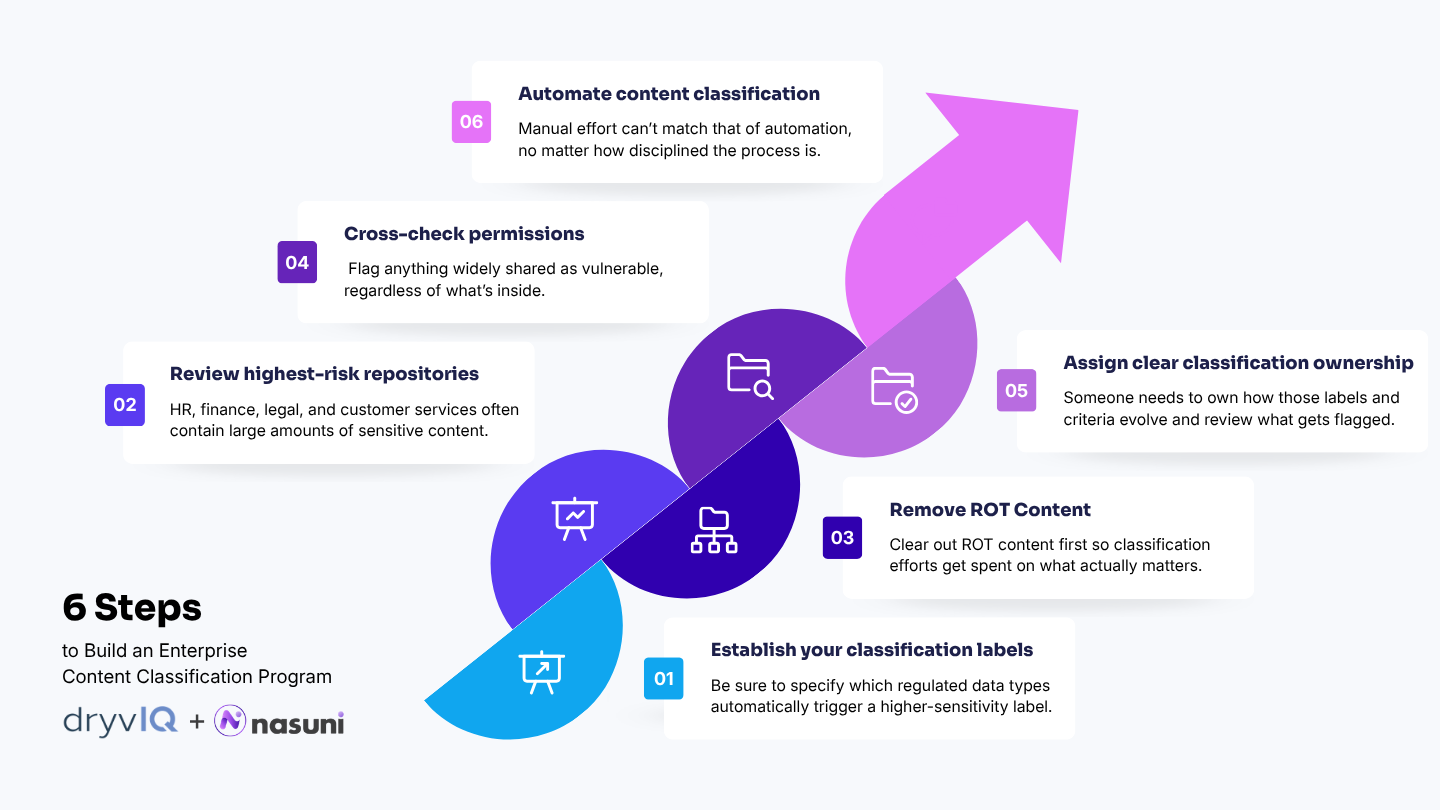
6 Steps to Build an Enterprise Content Classification Program
Closing this gap comes down to a short sequence of decisions that turn a vague sense of risk into something actionable, reducing the exposure of sensitive data for users, AI, and agents alike.
- Establish your classification labels as part of a formal policy. This is the step everything else depends on, and it’s the one most organizations skip. Most frameworks use a small set of sensitivity tiers, commonly Public, Internal, Confidential, and Restricted (or Highly Confidential), and define specific criteria for what qualifies at each level. That means specifying which regulated data types automatically trigger a higher-sensitivity label: PII, PHI, financial account data, trade secrets, and privileged legal communications, and tying each to the applicable regulations, from HIPAA and GDPR to state- and industry-specific requirements. The policy itself needs sign-off from legal, compliance, and security, not just IT. Without that policy in place, nobody (not a person nor a system) has anything to classify content against.
- Review your highest-risk repositories first. Human resources, finance, legal, and customer service departments often contain a disproportionate volume of sensitive content, so start there rather than attempting the entire content estate at once.
- Remove redundant, outdated, and trivial (ROT) content before you classify. Duplicate files, draft iterations, and content long past its useful life don’t need a sensitivity label – they need to go. Clearing ROT out of scope first means classification efforts, manual or automated, get spent on content that actually matters, not on files nobody will ever open again.
- Cross-check what’s left against permissions. Flag anything widely shared as vulnerable, regardless of what’s inside; a folder open to “everyone” carries a greater risk the moment something sensitive is added.
- Assign clear ownership for the classification policy, not just the labeling work. Someone needs to own how those labels and criteria evolve and review what gets flagged, whether the labeling is done by hand today or by a system tomorrow.
- Automate content classification. Once the policy is written, ROT is cleared, the highest-risk areas are flagged, and ownership is assigned, automation is crucial for accurate classification. File discovery and labeling run continuously, keeping pace with content as it’s created and shared, and applying the policy consistently across the entire estate. Manual effort can’t match that pace or that coverage, no matter how disciplined the process is.
The first steps are foundational for any organization seeking to ensure accurate classification across the content estate. The final step is where the gap closes for good.
6 Steps to Build an Enterprise Content Classification Program Infographic
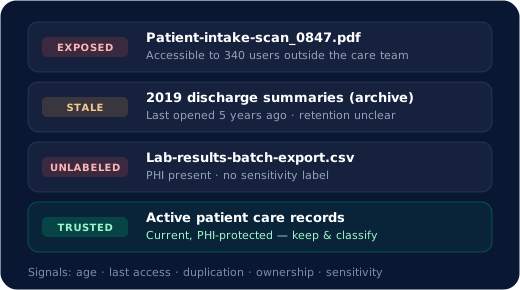
How Automated Content Classification Reduces Sensitive Data Exposure in AI
Automated content classification parses every file across the organization against the approved policy, applying the correct classification labels as content is created and modified across every repository at once. That coverage is what closes the gap that manual review never could – not because a person can’t spot a tax form or a patient diagnosis, but because no team can look at everything, every day, at the pace at which content moves now. Every classification decision is also documented and auditable, so when something is flagged, there’s a clear reason why.
That labeling is what allows AI tools and agents to treat sensitive content differently once it’s retrieved: withholding it, redacting it, or routing it for review rather than surfacing it like any other file. The stakes are higher with agents specifically, since a multi-step task doesn’t just display a file; it can pull that content into an email, a report, or another system entirely. Classification ensures that the content AI tools and agents draw on is relevant, organized, cleansed, and secured.
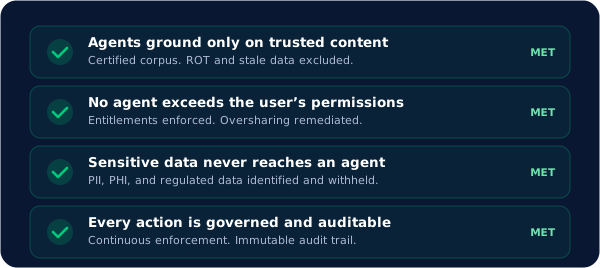
The same coverage pays off for people who use the content directly. A compliance team responding to an audit can pull exactly what’s relevant instead of reviewing a repository by hand. An employee searching for a specific record finds the right version instead of sorting through duplicates, and can trust that whatever a search, an AI tool, or an agent surfaces has already been verified as relevant and safe to use.
Classification Is What Makes AI Trustworthy With Sensitive Data
AI and agents didn’t create the sensitive data problem. They found the one that was already there, sitting in content nobody had classified (or cleared out in the first place). Closing that gap doesn’t mean slowing AI down. It means clearing out what doesn’t belong and classifying what remains, so permissions determine who can access a file and labels determine what happens once they do. That’s the difference between an AI deployment that stalls due to oversharing and one that scales.
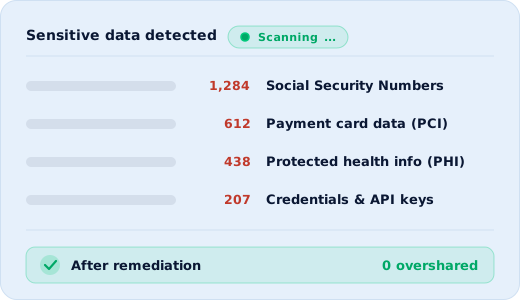
Not every organization waits for an incident to force this. Nicolet National Bank closed its classification gap before one ever forced the issue, working with DryvIQ to classify its content and give its security team the intelligence to act before sensitive data became a problem.
See how DryvIQ closes the classification gap before it reaches your AI tools.
Frequently Asked Questions
What is content classification?
Content classification is the process of identifying what’s inside a piece of content, whether it’s PII, PHI, financial data, or nothing sensitive at all, and applying a label that reflects that finding. “Content” here means unstructured data: documents, spreadsheets, emails, and similar files that don’t live in a structured database. Classification answers a different question than permissions do: permissions determine who can access a file, while classification determines what’s in it.
Why is content classification important for AI?
AI tools and agents that inherit a user’s permissions can only confirm who’s allowed to reach a file. Classification gives them something else to check: what the file contains, so sensitive content can be withheld, redacted, or routed for review instead of surfacing the same way an ordinary file would.
How do organizations classify enterprise content?
Classification is one component of enterprise content governance, and it starts with a documented policy that defines sensitivity labels (commonly Public, Internal, Confidential, and Restricted) and the criteria for each, including which regulated data types trigger a higher label. From there, organizations typically prioritize their highest-risk repositories, clear out redundant and outdated content so classification effort isn’t wasted on files that don’t need it, and then review what remains against the policy, either manually for smaller volumes or automatically at scale.
What happens if content isn’t classified?
Unclassified content can’t be treated differently based on its contents, whether by a person, a permissions model, an AI tool, or an agent. Sensitive data sitting in a technically permissioned location is exposed in the same way as ordinary content, which is how oversharing incidents occur even when access controls are working correctly, and why so many organizations have had to halt or delay their Copilot rollouts due to exactly this gap.
Is content classification the same as content governance?
No. Classification is one component of governance, not the whole of it. Content governance includes classification but also covers retention, access management, and lifecycle decisions such as archiving or deletion.

Krystal Elliott
• September 2, 2026
Let’s build the foundation for smarter decisions,
stronger security, and AI-powered outcomes.
Talk to an expert