
AI is only as good as the content underneath it. That’s not new; it’s why most pilots never make it to production. But the failure used to stay contained. Someone read the output, caught what looked off, and stopped it before it went anywhere. AI agents remove that checkpoint. The problem that’s followed AI since the beginning, ungoverned content, hasn’t disappeared – it’s just lost the human backstop that used to catch it.
At its core, a content governance framework decides who can access a piece of enterprise content and what they’re allowed to do with it. For years, “who” meant people, and, more recently, the AI tools that read alongside them. But now that “who” also includes AI agents, which don’t just read content, they act on it instantaneously.
According to , 97% of organizations have deployed AI agents or are piloting them, and 42% have written policies for what those agents are allowed to access. Fewer, only 31%, enforce those policies automatically as agents act in real time. The rules exist for a large share of organizations, but enforcement at agent speed is rarer.
Deploying an agent usually means pointing it at whatever the underlying account can already reach, not a boundary defined for the task. An agent pointed at an overshared folder doesn’t pause to consider whether it should have access, the way a person might. It finishes the task: the email goes out, the record updates, the data moves downstream, built on whatever it found.
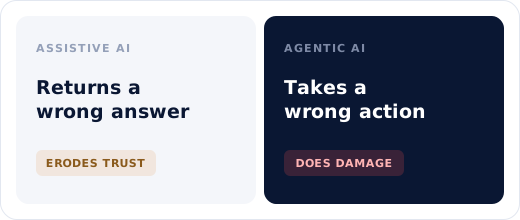
Without that pause, the control has to come from somewhere else. A content governance framework is not a new requirement in the AI era, but agents have made it impossible to put off any longer.
What a Content Governance Framework Is (and What It Was Built to Govern)
A content governance framework is the set of rules an organization applies to its content: who can see a file, what they can do with it, how long it’s kept, and when it gets removed. In practice, that covers four things: access, retention, disposition, and review. A fifth discipline, content classification, supports all four by identifying what a piece of content contains, so the right rules apply. Classification and governance aren’t the same thing. Classification answers what something is, while governance determines what happens to it.
Structured data has always been easier to govern this way, with defined fields, a schema, and often an owner. Unstructured content doesn’t get that by default: files sitting in SharePoint, cloud storage, and file servers usually inherit whatever rules were set up at implementation, followed out of habit rather than policy. That’s exactly what an agent inherits too, with no signal for which files are overshared or out of date.
An agent doing the wrong thing with content isn’t the agent failing. It’s proof the content it was given was never fit to be acted on in the first place. People have made that same kind of mistake for as long as they’ve had access to content they shouldn’t have, just at a scale and speed no single person’s error ever reached.
That’s what a governance framework has to catch: what users, AI, and agents can do once they can access a file. Governance and compliance owners used to keep pace by writing policy and checking its enforcement later. AI tools have already broken that pace, surfacing content faster than any person could review. Agents go further still; an AI tool still hands the decision to a person, but an agent doesn’t.
Why Content Governance Frameworks Stall, and What Makes One Hold
Content governance automation is what turns a written policy into action that scales across the enterprise. Most governance frameworks stall for four reasons:
- Rules are written down but not enforced. Policy exists as a document, with nothing checking whether the content underneath it complies.
- Manual review only. Someone eventually checks that the governance policy is being followed, but manual review can’t keep pace with how much content moves through a large enterprise in a single day.
- Policies are applied in a few systems, but inconsistent everywhere else. Coverage that varies by system means nobody can say with confidence what’s actually enforced across the estate, only what’s enforced in the systems someone got to first.
- The policy is automated but unchecked. An automated system corrects access, applies labels, and flags exceptions on its own, but nobody confirms whether the actions are correct.
The pattern echoes what’s already been documented about enterprise AI more broadly. Agents don’t introduce a new failure mode. They remove the last places it could hide. According to MIT NANDA’s 2025 research, 95% of generative AI pilots fail to deliver measurable financial value. Gartner has found that organizations with successful AI initiatives invest up to four times more in governance and data quality than those with poor outcomes. Success and failure both trace back to the same variable: what the content underneath looks like.
None of these problems get fixed by picking one solution over another. What works for most organizations is combining automation with human-in-the-loop validation: the system handles the volume, and a person confirms the results at key checkpoints, not every file, just the ones that matter most. That’s what turns a content governance strategy from something written down into something an organization can rely on, whether a person is reading the content or an AI tool or agent is acting on it.
What an automated content governance system can handle on its own
- Scanning repositories to find content nobody’s tracking
- Classifying what it finds: type, sensitivity, whether it’s stale or duplicate
- Correcting access when a file is overshared or mislabeled
- Applying retention and disposition rules to what’s already been classified
- Re-scanning regularly, so content is continually governed as it’s updated or created
Where content governance needs human intervention
Content governance and compliance decisions don’t disappear just because the rest of the framework runs on its own.
- Defining the policy itself: what counts as sensitive, how long something should be retained, who should have access to what
- Reviewing flagged exceptions (any files or decisions the system isn’t confident about)
- Approving anything irreversible, with permanent deletion being the clearest example
- Owning the outcome, and ensuring policies are kept up to date with changing business and regulatory requirements
Whoever owns that last responsibility also decides when the framework needs a second look: when a new repository is connected, or a new regulation is passed, rather than on a calendar date.
One policy across every repository
Ownership and review only work if there’s one governance state to review. Content classified and access-corrected in SharePoint can be exactly right, while the same categories of content sitting in a file server or cloud storage may never have been touched at all. An agent doesn’t check which system enforced the rule and which one didn’t. It acts on whatever it can reach. Enterprise content governance has to mean the same thing everywhere content lives, or it doesn’t mean much at all.
Content Governance Is What Lets AI Scale
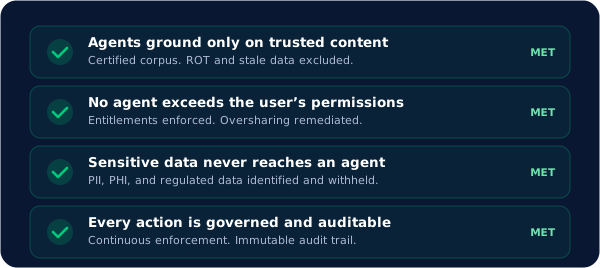
A content governance framework that can’t keep pace with a handful of agents today won’t keep pace as agentic AI becomes standard practice, rather than a pilot running in one corner of the business. Cracks in the framework don’t go away as adoption grows; they get found more often, by more agents touching more content, with less time for anyone to notice before the content’s already been acted on.
The organizations that come out ahead over the next few years won’t be the ones who deployed the most agents first. They’ll be the ones who treated content governance as infrastructure, something built before agents force the issue rather than a compliance checkbox addressed after something went wrong. That’s the same principle behind every AI ROI conversation happening in the enterprise right now.
A content governance framework is the foundation the AI investment sits on. Every dollar an organization spends on agentic AI assumes the content underneath it is trustworthy. Governance is what makes that assumption true, and what makes the ROI defensible.
DryvIQ helps organizations build that foundation: continuous scanning, classification, and cleanup across every repository.
Ready to see how DryvIQ can help you build a content governance framework that scales with AI? Talk to an expert.
Frequently Asked Questions
What is a content governance framework?
The set of rules an organization applies to its content: who can see it, what they’re allowed to do with it, how long it’s kept, and when it’s removed. It covers access, retention, disposition, and review, with content classification feeding all four by identifying what content actually is.
What should a content governance framework include?
Automated enforcement paired with human validation at key checkpoints, applied the same way across every repository where content lives, not just the systems that were easiest to start with.
How do you build one?
Start by moving off manual, inconsistent enforcement: automate the repeatable work (scanning, classifying, correcting access, applying retention), and keep a person in the loop for policy decisions, flagged exceptions, and anything irreversible.
Who owns governance?
Whoever is accountable for the decisions that still require a person: defining policy, reviewing exceptions, approving irreversible actions, and deciding when the framework itself needs a fresh look.
How often should a content governance framework be reviewed?
Not on a fixed schedule. Review gets triggered by a real change, a newly connected repository, a new regulation, a new way content gets used, rather than waiting for a date on the calendar to come around.
What is content governance automation?
The part of a governance framework that runs without manual intervention: scanning, classification, access correction, and retention enforcement, running continuously instead of on a periodic review cycle.
What processes should be automated?
The repeatable, rule-based work: scanning repositories, classifying content, correcting access, applying retention and disposition rules, and re-scanning on a recurring basis. Policy definition, exception review, and approval of irreversible actions stay with a person.
Can AI automate governance?
It can automate the repeatable, rule-based parts. Policy definition, exception judgment, and accountability for outcomes still require a person.
What are the benefits of automated classification?
It covers volume no manual process can match, applies the same standard to every file instead of varying by whoever reviews it, and keeps content current as it changes rather than describing a snapshot that’s already out of date by the time anyone reads it.
How do you automate governance across multiple repositories?
The same rules, applied the same way, in every system where content lives (SharePoint, shared drives, file servers, cloud storage alike) rather than automation that only covers wherever it was easiest to deploy first.

Krystal Elliott
• September 21, 2026
Let’s build the foundation for smarter decisions,
stronger security, and AI-powered outcomes.
Talk to an expert

Ready to see DryvIQ in action?
Stop drowning in data chaos. Start driving business outcomes.
Book a demo