
Request a demo and see how DryvIQ can help you build and maintain the foundation your AI needs to perform.
Enterprises are blaming the model for a problem that lives in the content underneath it; content no one ever managed as infrastructure.
That’s the real reason AI stalls, and it’s fixable.
The AI investment was made. The model was deployed. The ROI never came.
Ninety-five percent of generative AI pilots fail to deliver measurable financial value, according to MIT. Not because the technology doesn’t work (in benchmark after benchmark, it plainly does), but because, in production, it’s pointed at content no one prepared it to use.
This pattern is consistent across nearly every industry, use case, and model provider. If the problem were the model, a better model would have solved it by now. Frontier models have gotten dramatically better, and the failure rate hasn’t moved. That points past the model to the foundation it runs on.
Across the petabyte-scale content estates that DryvIQ has assessed, approximately 40% of the content fed to enterprise AI is redundant, obsolete, or trivial, and 39% carries sensitive data that was never properly governed. Most organizations have never measured this because, until AI began reading everything, no one had to.
Content became infrastructure by accident
Content wasn’t created to support AI. It accumulated across storage repositories and business applications as a byproduct of doing business. Decades of it.
That content is valuable; that’s why it’s being fed to AI in the first place. But sitting alongside the valuable material is outdated information, duplicate files, and sensitive data that was never properly managed, because until AI started reading all of it, no one needed to.
AI surfaces what it can find. Ask it to draft a client proposal, and it may build the pricing from a document three years old. It did exactly what it was asked, but outdated content resulted in poor output. It only takes a few answers like this before people stop trusting the system entirely.
That’s the root cause hiding under most failed AI rollouts: the content was never treated as foundational infrastructure that needs maintaining. AI didn’t create the mess. It was the first thing to read all of it at once, and expose it.
Agents raise the stakes from wrong answers to wrong actions
So far, this has mostly cost you trust. A person reads a bad AI answer, catches it, moves on warier. But that safety net is a human in the loop, and agentic AI removes it.
Autonomous agents don’t just answer from your content; they act on it, sending, updating, deciding, and triggering the next step continuously, at machine speed, with no one reviewing each move. Point an agent at content laced with stale, duplicated, or sensitive data, and you no longer get a wrong answer you can catch. You get a wrong action, taken and propagated before anyone sees it.
This is why, “we’ll clean it up later,” quietly expired. The moment agents began acting on your content, the foundation stopped being a nice-to-have and became a control system.
Manage content like the infrastructure it quietly became
Here’s the argument in one line: content is now infrastructure that AI and agents run on, and infrastructure has to be maintained continuously, not once.
The industry’s prevailing mistake is treating “AI readiness” as a project with an end date; clean the data, check the box, declare victory. But content doesn’t hold still. It’s created and changed every minute of every day, and agents are acting on it just as fast. A foundation prepared once is already out of date by the time the model reads it.
We call the gap this creates content debt: the compounding liability of unmanaged content sitting between your AI investment and its return. Like technical debt, it accrues silently, and every AI initiative you layer on top pays interest on it.
That’s the content foundation thesis: a foundation for AI isn’t a state you reach, it’s a system you run, governed continuously, at the speed content is created.
A maintained content foundation has four properties
Continuous
Governed as an ongoing system, not a one-time, pre-launch cleanup.
Current
Relevant and organized as fast as new content arrives and changes.
Clean & secure
Redundant, obsolete, and sensitive content handled before AI ever reaches it.
Measurable
You can prove the state of the content estate, not just assert it.
The content governance framework behind a strong AI foundation
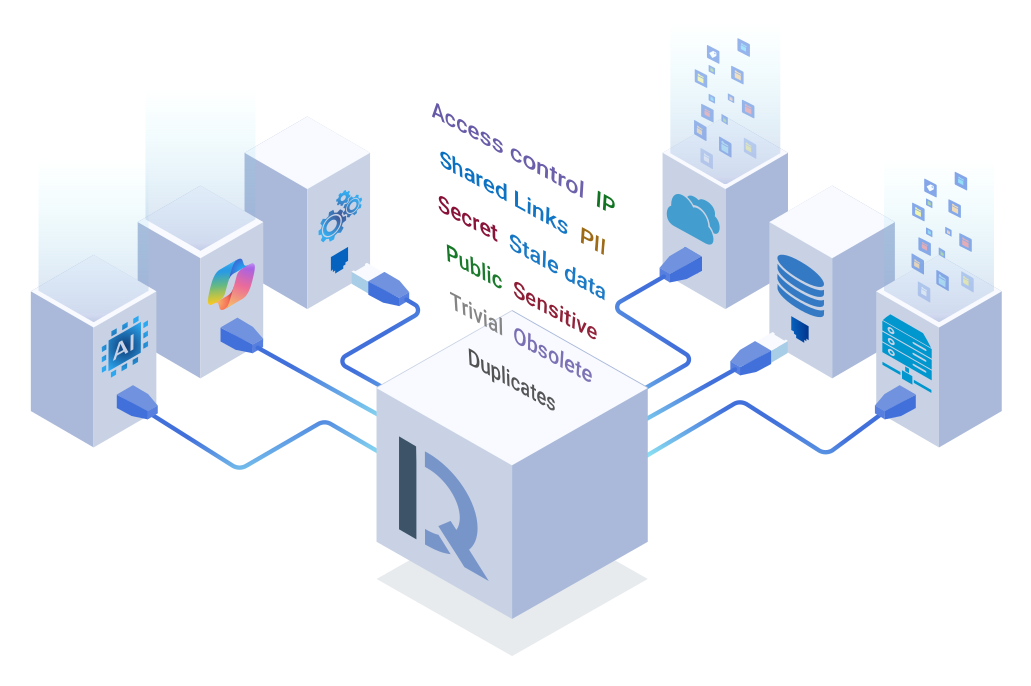
DryvIQ operationalizes the thesis as a single continuous system across three stages: Access, Classify, and Take Action. Working together, they keep content relevant, organized, cleansed, and secure as fast as it changes.
Access — Reach content wherever it lives
DryvIQ connects natively to 40+ content systems, closing the gap between where content lives and where AI can reach it. An unconnected repository is a blind spot no AI initiative will ever reach.
Classify — Know exactly what you're actually working with
DryvIQ classifies 5,000+ document types and 160+ sensitive entity types out-of-the-box, identifying exactly what’s carrying risk and what isn’t.
Take Action — Cleanse, organize, and govern content at scale
DryvIQ automates the work of keeping the content estate clean: redaction, anonymization, permission correction, sensitivity labeling, retention, and disposition. Done continuously, at petabyte scale.
Build the foundation once. Every AI initiative inherits it.
This is the part the ROI math turns on. A maintained content foundation isn’t a cost you carry for one project, it’s the ground every future initiative stands on. The next agent, the next model, the next use case: each one inherits a foundation that’s already clean, current, and governed, instead of paying down the same content debt from scratch.
Access, classify, and continually take action on your enterprise content, so every AI investment has what it needs to deliver the return you’re expecting.