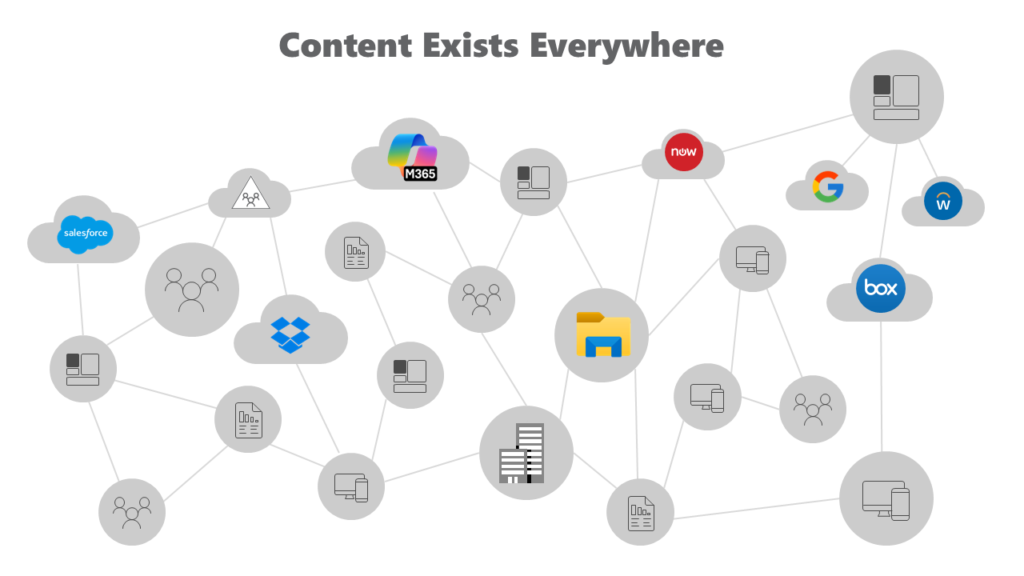
Somewhere in your organization, there’s a file share that hasn’t been touched in three years. A SaaS platform a department adopted during the pandemic that IT never fully integrated. A legacy repository from an acquisition that got migrated into the environment but never assessed.
The content in those systems is real. Your people know it exists, even if they’ve forgotten where. Your AI, however, does not. It’s making decisions without it.
That’s a visibility problem, and it’s the most common reason AI investments don’t return what they were supposed to.
The Content Visibility Gap Is a Value Gap
A 2025 MIT study found that 95% of generative AI pilots fail to scale from pilot to production. In most cases, the failure isn’t the model but rather what the model is running on. The most advanced model in the world, pointed at fragmented, incomplete content, will return fragmented, incomplete answers.
Enterprise AI tools (i.e., large language models, Copilot-style assistants, agents, or retrieval-augmented generation (RAG) pipelines) can only operate on the content they can reach. Whatever falls outside of that perimeter doesn’t inform outputs and doesn’t factor into decisions. As far as the model is concerned, it doesn’t exist. And critically, the model doesn’t know the difference: it returns the best answer with the same confidence whether it’s working from your complete content estate or a fraction of it. Nothing about the output signals what’s missing.
The gap between what the AI can access and what actually exists is almost always bigger than expected. Organizations that map their content estate for the first time routinely discover repositories they didn’t know were there: shadow IT platforms adopted department by department, redundant cloud storage repositories that never got consolidated, or on-premises file shares nobody has fully assessed. What looked like a manageable number of systems often turns out to be significantly more, with terabytes, or sometimes petabytes, of content the AI was never given access to. Or, just as often, content it does have access to but shouldn’t.
Nobody assigned governance accountability to those systems, so ownership defaulted to whoever happened to create the files. Those people had neither the training nor the incentive to govern content correctly. It shouldn’t come as a surprise, then, that only 16% of AI initiatives have scaled enterprise-wide, according to IBM’s 2025 CEO Study. The content ownership gap is a significant reason why.
Every system sitting outside the AI’s retrieval layer is value the organization is paying for but not receiving.
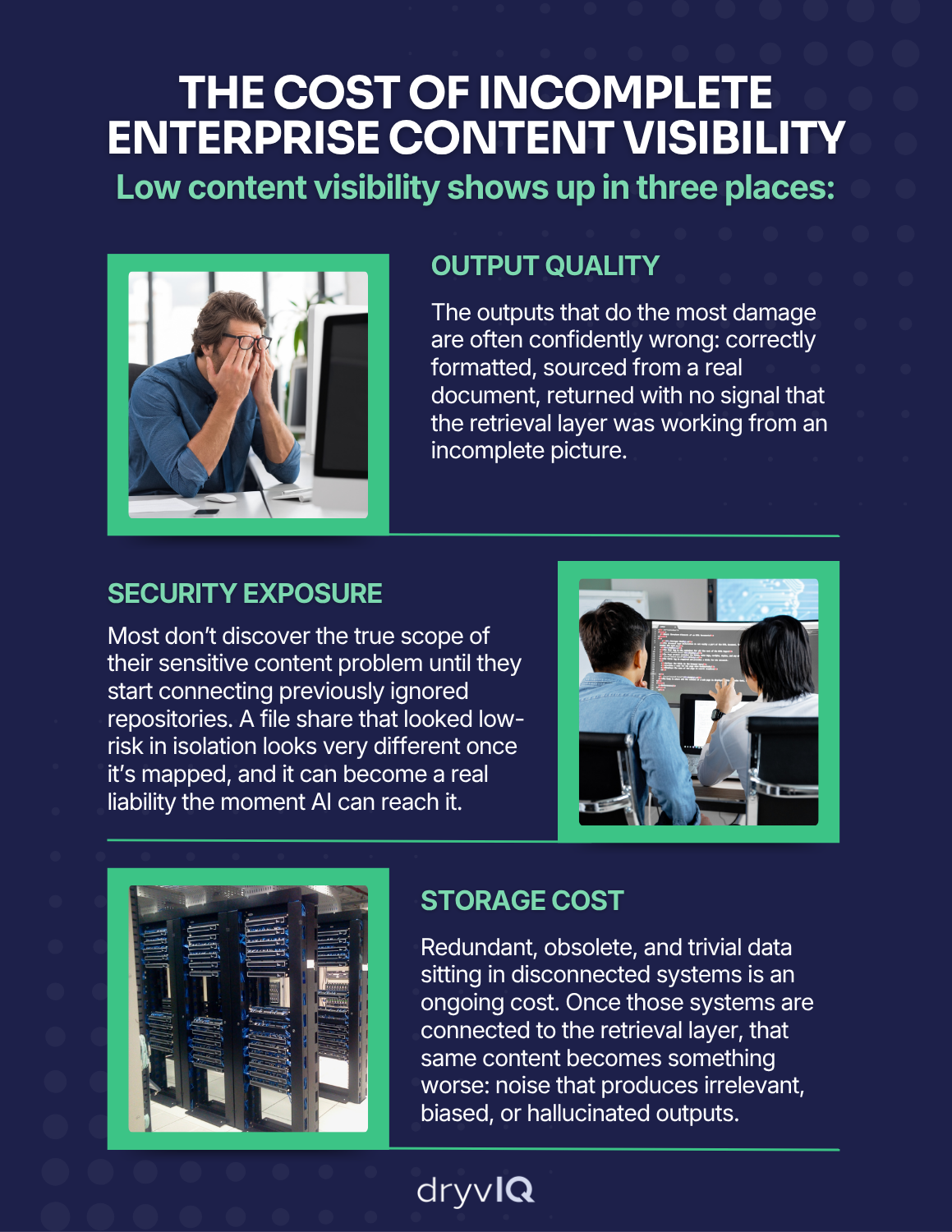
The Cost of Incomplete Enterprise Content Visibility
Low content visibility shows up in three places:
Output quality is the first sign something’s wrong. The outputs that do the most damage are often confidently wrong: correctly formatted, sourced from a real document, returned with no signal that the retrieval layer was working from an incomplete picture. A user who catches the error gets frustrated. A user who doesn’t may act on bad information before anyone realizes what happened. By then, trust is already eroding.
Security exposure is the second. Most organizations don’t discover the true scope of their sensitive content problem until they start connecting repositories they’d previously ignored. A file share that looked low-risk in isolation looks very different once it’s mapped alongside everything else, and it can become a real liability the moment AI can reach it. Closing the visibility gap and surfacing the security gap happen at the same time. That’s why a content inventory is often the most clarifying exercise an organization can run.
Storage cost is the third. Redundant, obsolete, and trivial (ROT) data sitting in disconnected systems is already an ongoing cost. Once those systems are connected to the retrieval layer, that same content becomes something worse: noise that produces irrelevant, biased, or hallucinated outputs.
Closing these gaps gives both your AI and your teams the complete picture they need to work from.
How to Close the Content Visibility Gap
The first instinct, for most organizations, is to migrate: consolidate everything into a single environment and start clean. That instinct isn’t wrong, but it’s usually premature. In most AI use cases, content doesn’t need to move to become useful; it needs to be accessible and governed where it already sits.
Migration is the right move when a system is genuinely a legacy platform, unsupported or being deprecated; modernizing that platform is part of building a durable content foundation. But migrating content that’s disconnected, without first addressing visibility and governance, just relocates the same fragmented, unclassified content into a new environment and recreates the same problem somewhere else.
This is the same discipline behind DryvIQ’s approach to enterprise content: Access, Classify, Take Action. Applied to the visibility problem specifically, it breaks down into three steps.

- Map every content repository in the environment.
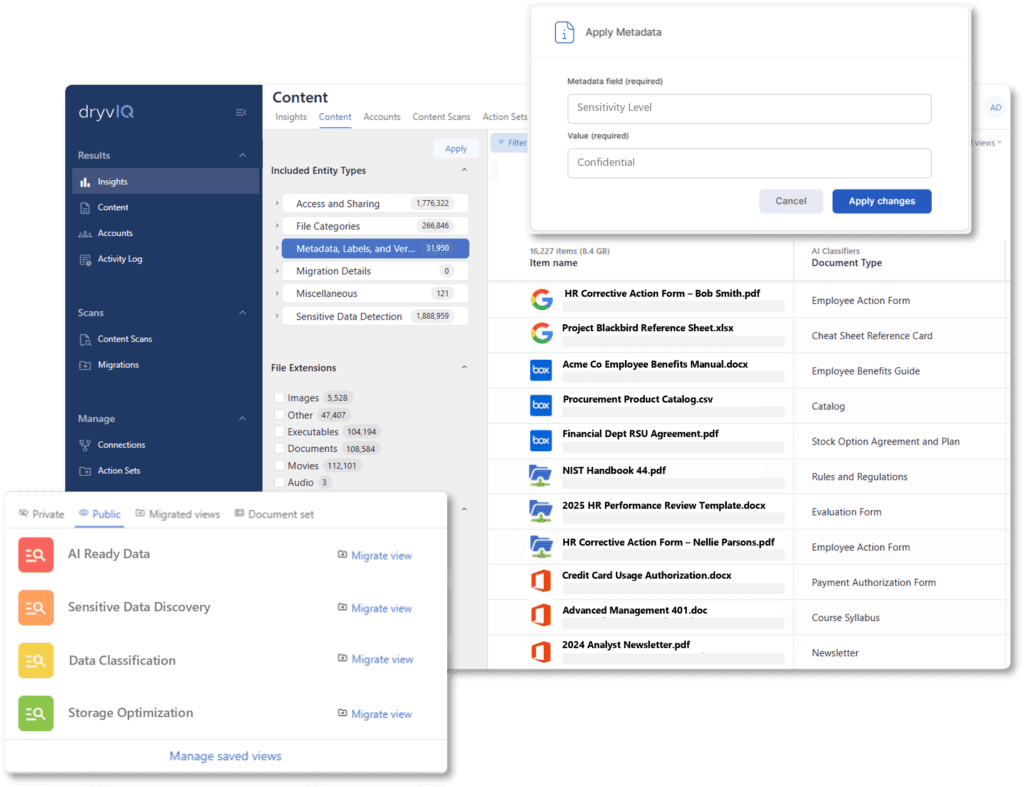
Assess the full content landscape (file shares, SaaS platforms, object storage, line-of-business applications, and legacy systems) and identify what the AI can already reach and what falls outside its retrieval layer. The resulting content inventory drives every governance, classification, and remediation decision that follows. - Connect unconnected systems at the repository level.
Native repository connectivity brings content into the AI’s retrieval layer without migration and without disrupting how users already work. Content stays where it lives; the retrieval layer expands to cover it. Output quality improves directly as scope expands, because the model is now working from a more complete picture of what the organization actually knows. - Classify and enrich across the full estate.
Connectivity alone isn’t enough. A connected repository full of content that’s unclassified, unlabeled, and thin on metadata gives the model more to process but not necessarily better results. Consistent classification, by document type, sensitivity category, and retention requirement, is what gives the model the signals it needs to rank content accurately, handle sensitive material appropriately, and return answers that reflect organizational reality. A content governance framework that runs continuously across the full estate is what makes that classification durable, rather than a one-time exercise that starts decaying the day it’s finished.
With these steps underway, the visibility gap closes. The AI works from a complete, governed picture of what the organization knows. Outputs become consistently reliable, sensitive content reaches only the people authorized to see it, and the investment starts returning what it was supposed to deliver in the first place.
The Real Question Isn’t “How Good Is Our AI?”
It’s “How much of our own organization can our AI actually see?”
For most enterprises, the honest answer is uncomfortable. But it’s the most actionable question you can ask this quarter, because unlike model selection or prompt engineering, closing a visibility gap is entirely within your control. The content already exists. The systems already exist. What’s missing is the connection between them and the AI you’ve already invested in.
See What Your AI Is Running On
DryvIQ makes enterprise content understood, governed, and cleansed at scale, connecting to 40+ content repositories so the AI tools you’ve already deployed can deliver the returns they were implemented to achieve.
Start with a conversation about what your content estate actually looks like. Speak with an expert.
The Cost of Incomplete Enterprise Content Visibility Infographic