
You use AI to draft a client proposal, then revise it as the deal moves: a new discount after the first call, adjusted terms after legal weighs in. With your AI assistant, each round of edits is a few prompts away, so you generate a fresh version and save it to the shared account folder so the team can review it. By the time the contract is signed, four versions sit side by side in that folder, and only the last one reflects what the client agreed to. Months later, someone on the customer experience team asks an AI assistant what terms the client has. It has access to all four, and nothing tells it which one is final.
Notice that nobody broke a rule. You saved your work where the team could find it, and AI read only what it was allowed to see. Permissions worked exactly as designed, and the answer can still be wrong.
Multiply this scenario by every employee with an AI assistant, and it’s clear why data volumes are growing so quickly. According to IDC, 57% of organizations are creating multiple variations of the same content more often since adopting generative AI, and 46% say the ease of generation has led them to save more similar or excess files. That is a new source of data sprawl, and it accumulates in the same repositories AI tools retrieve from.
That sprawl shows up on two bills. The first is storage. Stale content and duplicate data fill primary storage and collaboration platforms long after anyone needs them, pushing teams toward capacity limits and overage charges. The second is AI. As pricing shifts from seats to usage, with agents and assistants billed by the message, credit, or token, every redundant file pulled into an answer consumes budget without making the answer any better.
The result is clutter that raises costs on both fronts while lowering the quality of the answers AI provides. The pressure on AI returns is already high: 95% of gen AI pilots fail to deliver measurable financial value, according to research from MIT NANDA. With AI generating content faster than anyone can clean it up, data lifecycle management has to keep pace.

Why AI-Generated Data Sprawl Is Harder to Contain
Data sprawl is the uncontrolled spread of content and its copies across an organization’s systems, to the point where no one can confidently say where it all lives or which version is authoritative. Generative AI has accelerated this sprawl by making new versions faster and easier to produce than existing ones are to find, and by expanding who produces content.
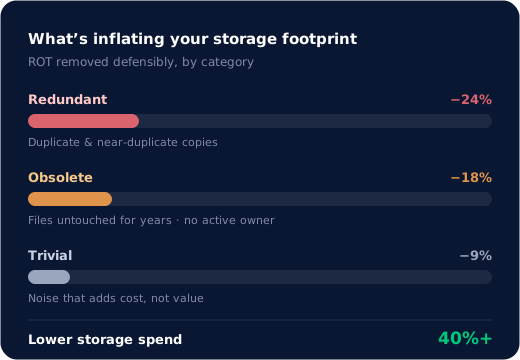
Most of it also goes undetected. AI-generated sprawl largely consists of near-duplicates: files that share most of their content but differ in the details that matter, like a discount rate or a contract term. Exact-match deduplication, the approach most cleanup efforts rely on, misses them, so these versions pass through as separate, equally legitimate files.
That detail matters most for AI. A retrieval system has no basis for knowing the correct version unless you add that context to the content, identify near-duplicates and keep them out of AI’s working set, and mark the authoritative version as current. Without that, AI tools confidently answer from whichever version best matches the question, whether right or wrong.
Why a One-Time Cleanup Can’t Keep Up With AI-Generated Content
The usual response to data sprawl is a cleanup project: inventory the repositories, remove the duplicates, archive what’s outdated, and call the estate ready for AI.
A cleanup project organizes and optimizes the content estate as it exists at that moment, not for the future. The next morning, employees go back to drafting proposals and reports with AI, and the near-duplicates start piling up again. Stale data, content that was accurate when it was created but no longer reflects current facts, builds up too, as deals close and policies change. A one-time project has no way to catch that drift later.
This is why governance initiatives stall when they’re run as projects. They’re scoped and funded to reach an end state, and AI-generated content doesn’t have one. What works is data lifecycle management: a continuous approach that decides, based on business value, where each piece of content should live, how it’s governed, and whether AI should reach it.
How to Build a Content Governance Strategy Around Data Lifecycle Management
A content governance strategy is an organization’s plan for managing content across its full lifecycle, so AI answers from the right version and storage costs don’t climb with every new draft. The strongest strategies replace guesswork with data, so every lifecycle decision reflects what content is actually worth to the business. Building one takes four steps, and each one builds on the last:
- Understand your content first. You can’t govern content you can’t see. Connect every repository where work happens, including the ones AI wasn’t originally deployed against, and build a content-level view of what each document contains, how sensitive it is, and whether it’s still current. Classification is central to that view: it surfaces near-duplicates and flags sensitive data as new content is created. Add activity and ownership, and you can understand the business value of each file, which turns lifecycle management from a judgment call into a data-driven decision.
- Manage and protect it everywhere. Content will keep living across many repositories, and it should; people work best where their work makes sense. What matters is applying the same rules to all of them, wherever content sits: remediate overshared permissions, apply sensitivity labels (such as Microsoft Purview Information Protection labels), redact or anonymize sensitive data, and keep an immutable audit trail. This is also where lifecycle decisions happen. Active, valuable content stays in primary storage, labeled so the authoritative version is clear. Content that has gone cold moves to a more cost-efficient tier, leaving a stub behind so people still find it where they expect. Content that policy says should go is retired, with owner review available for organizations that want that extra check.
- Activate only approved content for AI. Decide what AI apps and agents can retrieve, and enforce policy before AI reaches the content, not after an answer surfaces something it shouldn’t. When AI grounds on a governed, current set of content, answers are more accurate and fewer tokens go towards redundant files.
- Automate it so it runs continuously. New drafts are classified as they’re saved, and superseded versions are tiered or scoped out of AI’s path as needed. This is what separates a strategy from a one-time cleanup project.
Manage content this way, and the result is a trusted, governed content foundation that stays current, cost-efficient, and ready for AI no matter how fast AI adds to it.
Less Content Clutter Means Optimized Costs and Better Answers
When lifecycle decisions run continuously and are backed by data, the returns show up in two places:
- More efficient storage and AI spend. Tiering cold data relieves pressure on primary storage and helps avoid capacity overages, while stubs keep that content one click away. AI tools also have less redundant content to work through, so usage-based spend goes down as tool calls, context retrieval, and task runtime decrease.
- Answers people trust. Classified, governed content gives AI a trusted foundation. AI tools retrieve accurate, relevant content, so people can confidently act on the answers they provide. Adoption is more likely to hold after the pilot, and the AI investment starts delivering the returns it was bought for.
To prove it, track the outcomes leadership already watches: storage growth and overage charges, cost per AI answer, and whether adoption holds after the pilot.
AI will keep creating content, and the versions will keep coming. What matters is whether you manage them across their lifecycle or keep paying for them twice: once to store them, and again for AI to read them.
So here’s a question worth asking: how many times is your AI paying to read the same proposal?
Join us on November 10 for our webinar, “One Content Problem, Two Rising Costs: A Practical Look at Getting Ahead of It.” We’ll show how AI-generated sprawl drives up storage and AI costs at the same time, and which lifecycle decisions bring both back under control without losing access to the content your teams rely on. Register now to see what better-managed content could do for your AI spend and the answers it delivers.

Frequently Asked Questions
What is data sprawl?
Data sprawl is the uncontrolled spread of content and its copies across an organization’s systems, to the point where no one can confidently say where it all lives or which version is authoritative. It raises storage and AI costs and makes it harder for AI tools to find accurate information.
How does generative AI contribute to data sprawl?
Generative AI makes new drafts faster to produce than existing ones are to find, so employees often regenerate content instead of searching for it. The result is a growing number of near-duplicate files saved across shared folders, cloud storage, chat threads, and email.
How does duplicate data affect AI accuracy?
AI tools answer from the content they retrieve. When several near-identical versions of a document exist, AI retrieval has no reliable way to tell which is current, so an answer drawn from an outdated draft can sound as certain as one drawn from the correct version.
What is stale data, and why does it matter for AI?
Stale data is content that was accurate when it was created but no longer reflects current facts, such as a superseded proposal or a retired policy. AI tools treat it the same as current content, so it can surface in answers people act on. It also occupies primary storage long after anyone actively uses it.
Why isn’t a one-time cleanup enough?
A cleanup project organizes content as it exists on the day it runs. Users and AI tools keep generating new drafts and variations, so sprawl rebuilds unless you retire redundant copies and tier stale versions continuously.
What is data lifecycle management?
Data lifecycle management is the practice of managing content from creation through retention based on its business value. For AI-generated content, that means understanding what each file contains and whether it’s current, managing and protecting it across every repository, tiering cold data to more cost-efficient storage, and activating only approved content for AI.
How does content quality affect AI token costs?
AI tools that charge by usage bill for the content they retrieve and process. When repositories hold multiple versions of the same document, AI spends tokens reading redundant or outdated files, which raises the cost of each answer and makes it less reliable. Governing which content AI reads lowers cost per answer and improves accuracy.
How do you create a content governance strategy?
Start by understanding content across every repository: what each file is, how sensitive it is, and whether it’s still current. Then manage and protect it wherever it lives with consistent permissions, labels, and lifecycle policies, including tiering cold data to a more cost-efficient tier with a stub left behind. Finally, control which content AI can retrieve, so it grounds only on approved, current content. Automate those decisions so they run continuously, and measure the results in optimized storage and AI spend, fewer wrong answers, and improved AI ROI.