
A global business services firm recently came to us not with an AI problem, but a content problem. Petabytes of client data were spread across regions and industries. Critical knowledge was buried in unstructured content repositories. Metadata was incomplete, inconsistent, or missing entirely. Sensitive information was at risk of exposure if made accessible to AI.
We’ve heard similar, if not identical, stories from organizations across just about every sector: the AI ambition is there, but the content isn’t ready.
Early AI assumptions suggested that more data would lead to better models. But as use cases have matured, the reality of “garbage in, garbage out” has become undeniable.
AI requires precision to generate meaningful results, and most enterprise content is anything but precise. Fragmented repositories, inconsistent metadata, and unmanaged sensitive data undermine even the most advanced AI initiatives. Without trusted, well-governed content, AI cannot deliver a reliable return on investment.
But here’s what most organizations miss: content readiness isn’t the destination. Activation is. Preparation gets your content AI-ready. Activation is what turns it into a return on investment. Without the second step, the first is wasted.
Why Unmanaged Content Becomes an AI Roadblock – And What It Costs You
When the business services firm ran its first content audit, the results were stark. There was no unified view of what existed, where it lived, how old everything was, if duplicate data existed, where the sensitive and confidential information lived, or who could access what. AI pilots leveraging this content produced outputs that were inconsistent at best, unreliable at worst. Sound familiar?
Simply put, unmanaged content creates three compounding problems for AI initiatives:
- Noise and hallucination. If redundant, obsolete, or trivial content isn’t archived or deleted, model outputs become prone to hallucination, noise, and bias. When AI can’t distinguish signal from noise, outputs become unreliable, and once teams lose confidence in AI outputs, adoption stalls.
- Lost context. Without consistent classification and enriched metadata, AI struggles to accurately interpret unstructured content. Finding, connecting, and analyzing information across repositories becomes slow and error-prone. The value that justified the AI investment quietly evaporates.
- Compliance exposure. Content that hasn’t been properly redacted, encrypted, or anonymized (or that lacks enforced governance and access controls) becomes a liability the moment it enters an AI pipeline. Privacy and compliance risks, regulatory exposure, and eroded user confidence follow.
These aren’t hypothetical risks. They’re the reason why most AI pilots never make it into production. They’re the reason many CEOs say AI hasn’t generated revenue or cost savings for their business. The good news: this is solvable with the right approach.
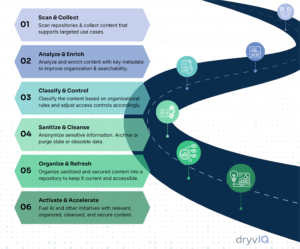
The Six-Step AI-Readiness Roadmap
Before scaling AI initiatives, organizations need a structured, repeatable approach. This roadmap turns fragmented content environments into organized, secure, context-rich ecosystems, ready to be activated for AI use cases that deliver compounding ROI.
- Scan & Collect: Identify and aggregate content across repositories, focusing on documents that support high-value AI and business use cases. For the business services firm, this step was a turning point. They discovered just how fragmented their environment was. No unified view. No clear picture of what existed or where. That visibility alone changed how leadership thought about the problem.
- Analyze & Enrich: Use AI-powered analysis to extract insights and enrich content with key metadata. This step ensures that every file carries the context required for accurate discovery, model training, and downstream automation, directly reducing time-to-find and improving the accuracy of AI outputs. For the business services firm, enriching metadata transformed fragmented repositories into a navigable knowledge base.
- Classify & Control: Categorize content according to organizational rules and apply access controls to ensure sensitive information is protected while relevant teams have the information they need. For the business services firm, client confidentiality requirements made this step non-negotiable. Classification and access enforcement had to happen before any content could be made available to AI systems.
- Sanitize & Cleanse: Apply automated anonymization to protect sensitive data, archive or purge outdated content, and maintain a clean foundation for AI training and deployment. This is the step that makes your AI trustworthy, not just functional. Garbage removed here stays removed; crucial for protecting data privacy and preserving output quality on an ongoing basis – and compounding the quality of every output that follows.
- Organize & Refresh: Structure content into managed repositories that remain current and accessible to both human and AI users. Governance isn’t a one-time project; this step ensures the foundational dataset stays clean, even as new content is continuously created. Without it, you’re solving the problem once. With it, you’re building a system that solves it permanently.
- Activate & Accelerate: Deliver trusted, high-quality content to fuel AI models, analytics projects, and other initiatives, with measurable gains in decision speed, model accuracy, and operational confidence. This step is where AI investments pay off. For the business services firm, this wasn’t the end of the process. It was the beginning of their AI ROI as each new use case built on the clean, governed foundation the previous steps had created.
The Strategic Impact of AI-Ready Enterprise Content (What Happens When You Do this Right)
By following this roadmap, the business services firm transformed how its teams work, how they leverage AI, and how confidently they make decisions, resulting in:
- Significantly improved enterprise search and content discovery. Teams across regions and business units could surface critical content in a fraction of the time previously required, eliminating the hidden productivity tax of searching fragmented repositories.
- Higher-confidence AI outputs with built-in compliance guardrails. Model accuracy improved as noise was removed and context was enriched, while sensitive and confidential information remained protected.
- A scalable framework that compounds in value over time. Content governance became a living system, not a one-time project, supporting informed decision-making across teams, regions, and use cases as the organization’s AI ambitions grow.
The impact goes beyond AI initiatives. Content that is organized, clean, and secure becomes a strategic enterprise asset, enabling faster decisions, reducing operational risk, and delivering measurable ROI across the organization.
Those Winning with AI Aren’t Waiting for Perfect Data
The organizations closing the gap between AI potential and AI performance aren’t waiting for perfect data. They’re activating what they have, systematically, repeatably, and with a clear view of the ROI at each step.
Our eBook, “A Practical Guide to Making Enterprise Content AI-Ready” goes deeper: worksheets, frameworks, and strategic actions you can take today to build the foundation your AI initiatives need.
Download the eBook to explore the full roadmap and take your first steps towards scalable, reliable AI today.

Krystal Elliott
• April 13, 2026
Let’s build the foundation for smarter decisions,
stronger security, and AI-powered outcomes.
Talk to an expert

Ready to see DryvIQ in action?
Stop drowning in data chaos. Start driving business outcomes.
Book a demo