
As AI investments continue to grow, many organizations find their pilots stall before they can scale them to deliver meaningful impact.
In my experience, the barrier to success is rarely the model or the initiative itself; instead, it’s the content that fuels AI. In other words, many of those failures are due to the strategy missing a critical factor in AI success: effective content lifecycle management.
The level of management (or mismanagement) of content across every stage—from creation to disposal—directly impacts data quality, compliance and AI outcomes. When enterprises lose visibility into what they have and what they can use to drive value, it undermines the potential of even the most impactful AI initiatives.
Organizations that take a more structured approach to the content lifecycle can turn scattered and unclassified data into information that is easier to manage and more reliable for AI use.
Why Even Valuable Data Can Become A Liability
Organizations are rapidly accumulating data that quickly outlives its purpose. Knowledge workers are constantly creating, updating, duplicating and sharing files across multiple systems.
As this happens, as I’ve written about before, stale or unmanaged content accumulates throughout the enterprise. According to Splunk research, as much as 55% of an enterprise’s data is considered “dark”—stored but never analyzed or properly managed. Much of this dark data contains sensitive or confidential information, increasing exposure and regulatory risk, especially if it’s used in AI model training.
This liability is particularly prevalent in mergers and acquisitions. Deal rooms often contain large volumes of confidential information. Associates download and extract files for analysis, creating multiple copies that are stored across both personal and shared drives. When a deal is closed, those files are rarely deleted. The result is a trail of orphaned information, likely containing sensitive data. The organization loses sight of where this data lives, who has access to it and how it’s being used.
Hidden pockets of dark, unmanaged content like this can lead to compliance violations and unnecessary operational costs, while also undermining AI and analytics initiatives. Feeding systems with incomplete, redundant or sensitive data reduces insight, introduces bias and slows adoption, making it difficult for organizations to deploy AI at scale.
Why AI Success Depends On Managing The Content Lifecycle
The solution lies in disciplined content lifecycle management: treating every stage as an opportunity to make data more accurate, organized and actionable.
To do this effectively, organizations need to understand the role that each stage of the lifecycle—from document creation through disposal—plays in data quality, governance and relevance:
- Content Creation: Content originates across emails, business applications and external systems. Understanding its origin helps prevent blind spots that can compromise downstream use.
- Content Residency: Content lives across various repositories: foundational storage, distributed file systems, collaborative platforms and structured systems. How it is stored, moved or synchronized affects discoverability, governance and usability.
- Content Governance: Metadata enrichment, classification and labeling, data anonymization and access insight and control ensure content is secure, compliant and meaningful. Without governance, sensitive data can lurk unnoticed within systems, creating vulnerabilities.
- Content Disposition And Disposal: Stale or redundant content obscures insights and reduces the accuracy of AI outputs. Proper retention management, archiving and deletion ensure only relevant, trustworthy content makes its way into training datasets.
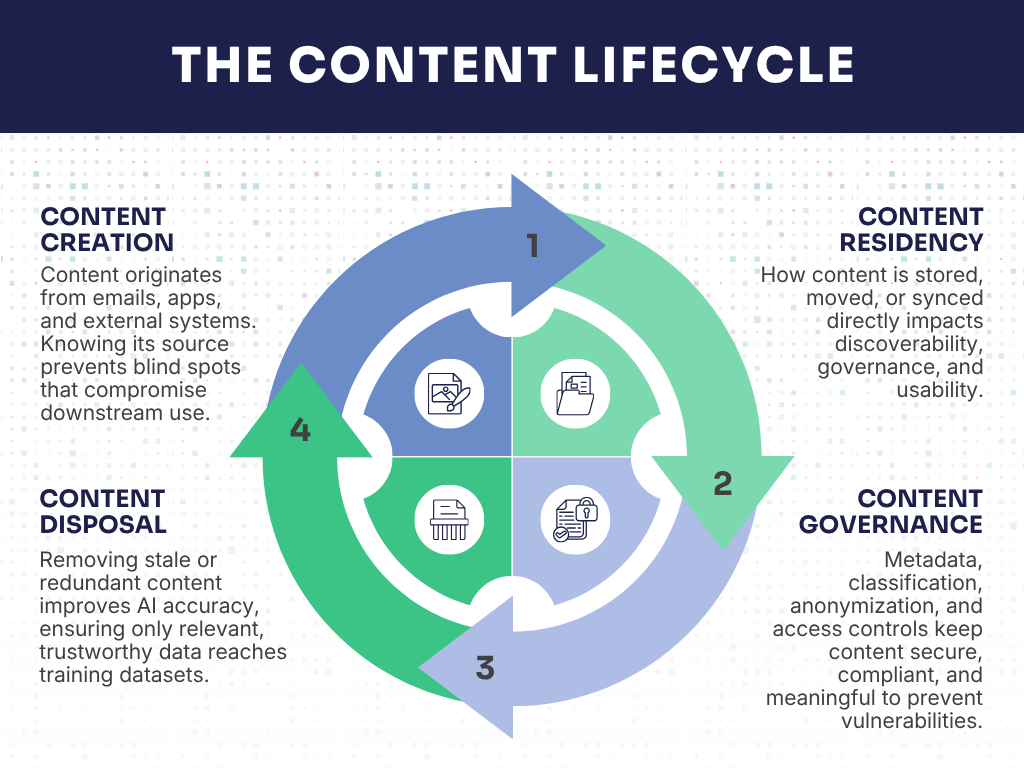
Viewed holistically, the content lifecycle provides a framework for understanding where risks lie and where value can be unlocked. Organizations that maintain visibility and consistency across these stages are better positioned to feed AI systems with the high-quality, accurate information that they rely on.
Building An Intelligent Content Lifecycle Strategy
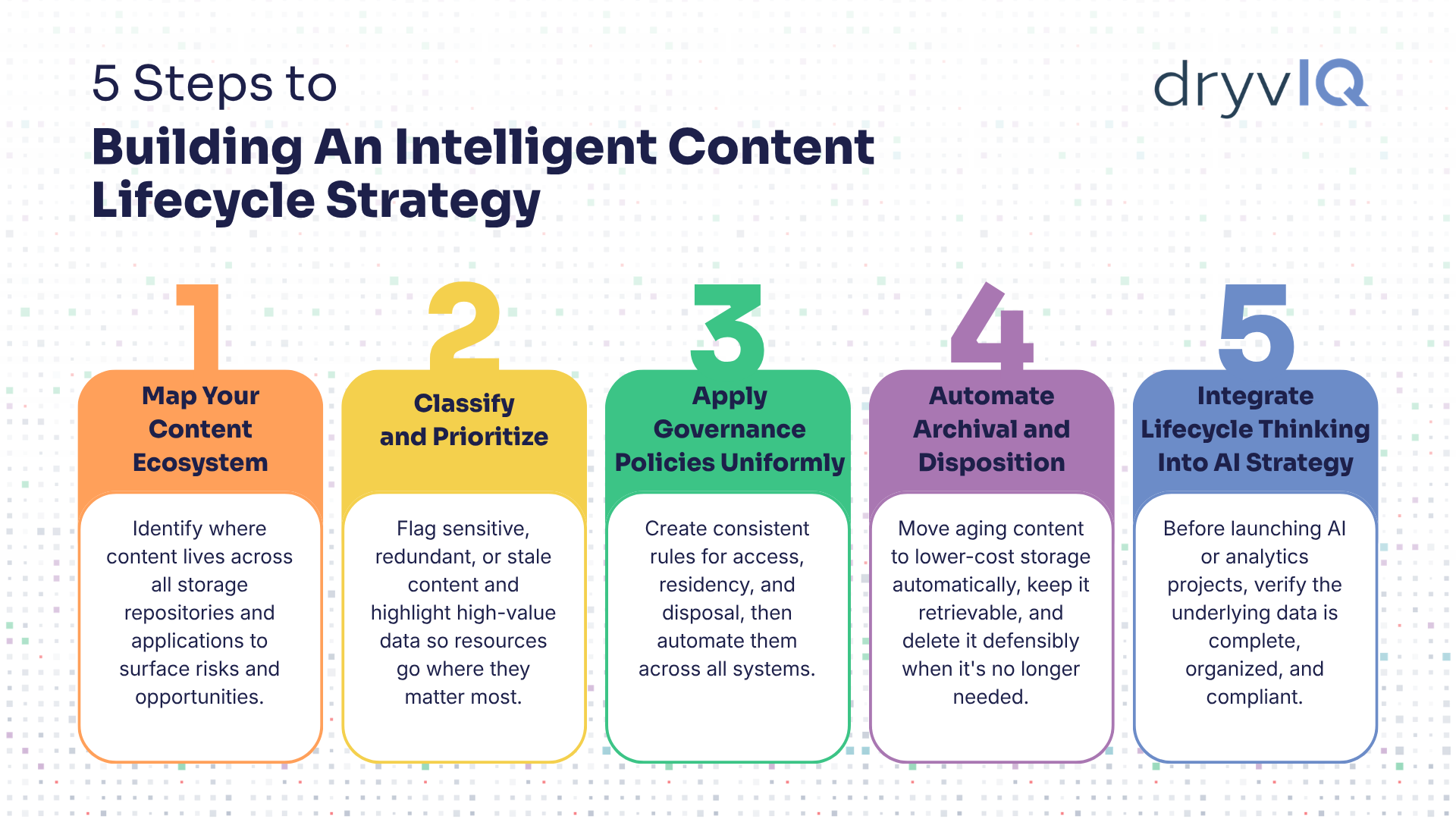
An intelligent content lifecycle strategy creates consistency, structure and automation across every stage and storage repository. The goal is to ensure content has a clear purpose, is properly governed and has a defined end of life. Here is what a content lifecycle strategy entails:
1. Map your content ecosystem. Learn where content resides across all storage repositories and applications. Visibility is the first step to identifying risks and driving value.
2. Classify and prioritize. Determine which content is sensitive, redundant or stale, and identify high-value, business-critical data. Prioritization ensures resources focus on the areas that matter most.
3. Apply governance policies uniformly. Develop consistent policies for residency, access, governance and disposal. Automating these rules can help ensure content is managed uniformly across all systems.
4. Automate archival and disposition. Decisions about data should be grounded in purpose, relevance and risk, rather than focusing on catch-all rules like age. Move older content to lower-cost storage automatically, but keep it easy to find and bring back if someone needs it. Then, once content has truly reached the end of its usefulness, it should be deleted in a defensible way. Giving users the ability to “rehydrate” archived files helps organizations feel more comfortable archiving more proactively.
5. Integrate lifecycle thinking into AI strategy. Before deploying new AI or analytics projects, evaluate whether the underlying data is complete, organized, compliant and ready to fuel upcoming initiatives.
The Overlooked Foundation Of AI Readiness
Successful AI adoption depends on the integrity of the content that supports it. Enterprises that apply intelligent lifecycle management gain control over one of their most complex and valuable assets: unstructured data.
Treating the content lifecycle as a strategic priority allows organizations to operate with cleaner, safer and more actionable data. That data readiness accelerates transformation, improves compliance and strengthens confidence in every AI-driven decision.
This article was originally published with Forbes Tech Councils.