
Enterprise content is everywhere; across collaboration platforms, shared drives and line-of-business applications, users and systems generate and store vast amounts of information every day, and volumes will only increase as GenAI and agents accelerate content creation. But in this disconnected environment, many organizations cannot answer a simple question: Who’s responsible for the governance of the content inside these systems?
I ask this in nearly every conversation I have with enterprise leaders, and the answer is rarely the same. Sometimes it’s end users, sometimes IT, sometimes a CIO. This lack of clarity creates a content ownership gap: a space where enterprise content grows without accountability for its quality, governance or long-term value. Most often, end users have become content owners by default, and beyond lacking the training, they have better things to do than ensure their information is governed correctly.
As organizations accelerate their investment in GenAI, this ownership gap becomes more than a data governance issue. These initiatives depend on relevant, contextualized, AI-ready content. Without clear ownership of the content life cycle, enterprises increase their risk and limit their ability to scale AI initiatives.
What Gets Lost In The Content Ownership Gap
When ownership is unclear, consistent governance is nonexistent. Corporate policies may exist, but enforcement varies by platform, department and end user (if there is any enforcement at all). Employees come and go, and content changes hands. Stale and duplicate data accumulate, obscuring high-value and relevant information and driving up storage costs.
Search performance suffers, and productivity follows suit. Decision-making slows when teams question whether the information they find is complete, up to date or relevant.
The impact of this ownership gap is even more pronounced when organizations scale AI across their operations. These systems depend on relevant, organized, cleansed and secure data to perform, but estimates suggest that less than 1% of enterprise data is suitable for AI consumption. So it comes as no surprise that, according to IBM’s 2025 CEO Study, only 16% of AI initiatives have reached enterprise scale.
How Content Ownership Starts At The Top
Closing the content ownership gap starts with a top-down strategy that treats content as a shared enterprise asset rather than a by-product of individual systems.
Because the content landscape is so vast, this strategy must be defined at the executive level (typically by a CIO, chief data officer or similar role). The first step is to agree on what high-quality, AI-ready content means for your organization.
In practice, AI-ready content shares a core set of attributes. I define “AI-ready content” as content that is relevant to the initiative, organized to support discovery and model training, clean from a data privacy and sensitivity standpoint, and secure throughout its life cycle.
From there, executives can develop enterprise-wide policies for metadata, content residency, retention and deletion, anonymization or redaction, compliance and more—policies that ensure content has all of the required attributes to meet the standard of “AI-ready.” These rules do not need to be complex, but they must be consistent and enforceable across platforms.
Without a top-down strategy, platform owners and end users will create their own rules, leaving the ownership gap wide open.
The Role Of Content Platform Owners
But strategy alone doesn’t close the gap. Execution happens at the platform level.
Platform owners (the admins behind collaboration tools, storage repositories and enterprise applications) are best positioned to execute the strategy because they sit at the intersection of technology, governance and everyday usage. Unlike end users, they have the visibility and tools to automatically apply standards across their entire system rather than file by file
Armed with the strategy, platform owners become responsible for managing the content life cycle within their domains: reducing redundant and outdated content, ensuring required metadata is applied and maintaining compliance with security and privacy requirements.
Shifting accountability from end users to platform owners reduces inconsistency, lowers risk and ensures content is always ready for AI, analytics and other data-driven initiatives.
Four Steps To Closing The Content Ownership Gap
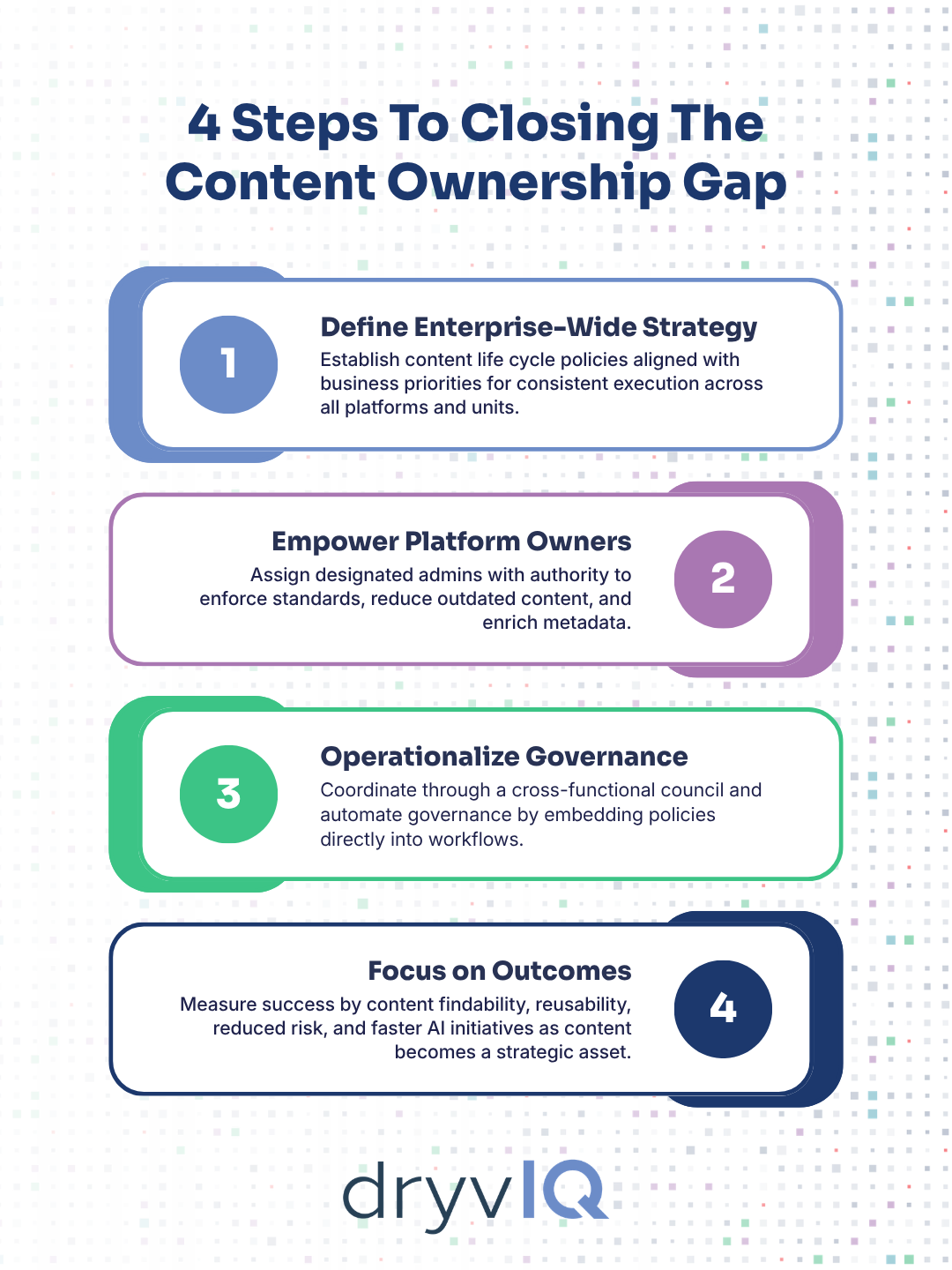
Closing the content ownership gap requires an operating model that connects strategy to content management. Organizations that are set up to succeed tend to follow these four steps:
1. Define an enterprise-wide strategy and rules.
Leaders must establish enterprise-wide content life cycle management policies that can be applied consistently across platforms and business units. These rules should be aligned with business priorities, creating a shared strategy for content platform owners to execute across the organization.
2. Empower content platform owners to execute.
Each content platform should have a designated owner responsible for ensuring compliance with enterprise standards. These admins need the authority to enforce policies, reduce redundant and outdated content, enrich metadata and ensure information is usable for downstream initiatives.
3. Operationalize governance across the organization.
Consistency at scale requires coordination. A cross-functional council can help platform owners interpret standards, resolve exceptions and stay aligned as platforms and enterprise priorities evolve. Governance should be automated wherever possible, embedding metadata enrichment and life cycle enforcement directly into workflows.
4. Focus on outcomes.
When ownership is applied consistently, risk and operational inefficiency decline. Content becomes easier to find, trust and reuse. AI initiatives move faster because models can rely on governed, high-quality information. Over time, content shifts from a liability to a strategic asset.
Why Closing The Content Ownership Gap Matters Now
The focus on GenAI has made content ownership a critical issue. AI systems are only as effective as the content they consume, and many organizations are discovering that siloed, inconsistently governed content limits their ability to move from pilot to production.
When ownership is clear, risk declines because governance becomes enforceable. Content quality improves because information is curated and contextualized. AI initiatives accelerate because models can rely on consistent, trustworthy inputs.
In an environment where outcomes depend on execution rather than experimentation, closing the content ownership gap becomes critical. Organizations that pair clearly defined ownership with executive-led governance standards are better positioned to scale AI, make smarter decisions faster and deliver better results—and those that don’t may struggle to scale any initiative that requires high-quality content.
This article was originally published with Forbes Technology Council.

Sean Nathaniel
• March 24, 2026
Let’s build the foundation for smarter decisions,
stronger security, and AI-powered outcomes.
Talk to an expert

Ready to see DryvIQ in action?
Stop drowning in data chaos. Start driving business outcomes.
Book a demo